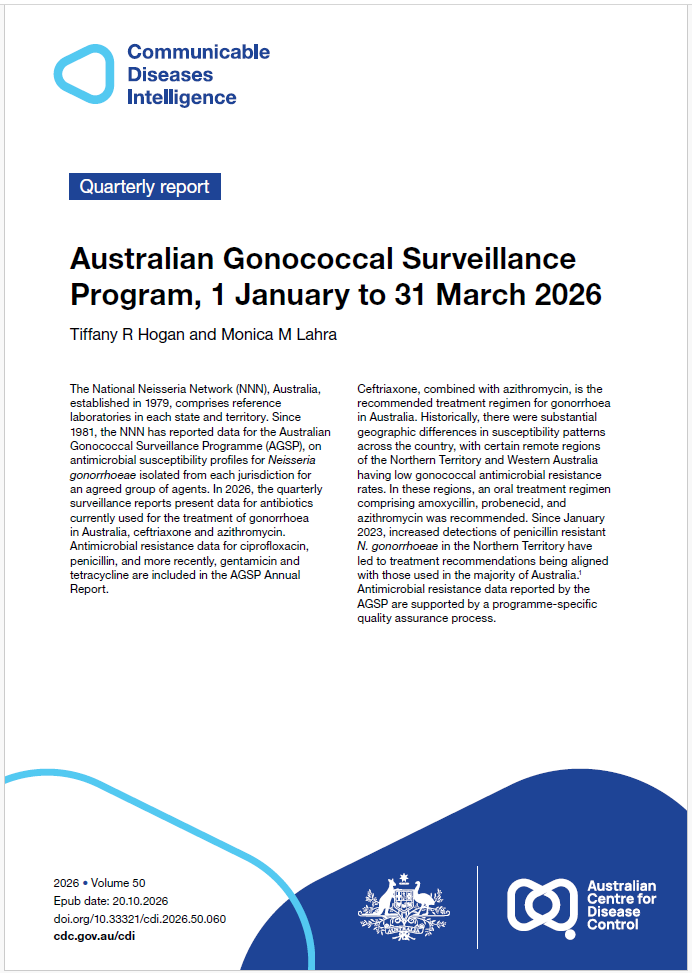
Australian Gonococcal Surveillance Program, 1 January to 31 March 2026
DOI:
https://doi.org/10.33321/cdi.2026.50.060Keywords:
antimicrobial resistance, disease surveillance, gonococcal infection, Neisseria gonorrhoeaeAbstract
The Australian National Neisseria Network (NNN) comprises reference laboratories in each state and territory that report data on antimicrobial susceptibility testing to an agreed group of antimicrobial agents for the Australian Gonococcal Surveillance Programme (AGSP). The AGSP data are presented quarterly in tabulated form, as well as in the AGSP annual report. This report presents national gonococcal antimicrobial resistance surveillance data from 1 January to 31 March 2026.
Downloads
References
Northern Territory Government Department of Health (NT Health) Centre for Disease Control. Penicillinase-producing Neisseria gonorrhoeae (PPNG) and treatment recommendations for gonorrhoea. Darwin: NT Health; 11 March 2024. [Accessed on 11 July 2024.] Available from: https://health.nt.gov.au/__data/assets/pdf_file/0008/1356146/health-alert-ppng-240311.pdf.
World Health Organization (WHO). Global action plan to control the spread and impact of antimicrobial resistance in Neisseria gonorrhoeae. Geneva: WHO; 2012. Available from: https://apps.who.int/iris/handle/10665/44863.
Lahra MM, Hogan TR. Australian Gonococcal Surveillance Programme Annual Report, 2025. Commun Dis Intell (2018). 2026;50. doi: httos://doi.org/10.33321/cdi.2026.50.057.
van Hal SJ, Lahra MM, Whiley DM. Determining targets for ceftriaxone resistance detection in Neisseria gonorrhoeae based on genotype-phenotype data: an observational study. Lancet Microbe. 2025;6(11):101199. doi: https://doi.org/10.1016/j.lanmic.2025.101199.
van der Veen S, Sun X, Ge H, Chau TM, Nhung PH, Vandelannoote K et al. PenA alleles associated with gonococcal ceftriaxone resistance in Cambodia, China, and Vietnam. Clin Infect Dis. 2026;81(Suppl 5):S238–42. doi: https://doi.org/10.1093/cid/ciaf530.
Tapsall JW, Ndowa F, Lewis DA, Unemo M. Meeting the public health challenge of multidrug- and extensively drug-resistant Neisseria gonorrhoeae. Expert Rev Anti Infect Ther. 2009;7(7):821–34. doi: https://doi.org/10.1586/eri.09.63.
van Hal SJ, Sherry N, Coombs G, Mowlaboccus S, Whiley DM, Lahra MM. Emergence of an extensively drug-resistant Neisseria gonorrhoeae clone. Lancet Infect Dis. 2024;24(9):e547–8. doi: https://doi.org/10.1016/S1473-3099(24)00486-9.
Lahra MM, van Hal S, Hogan TR. Australian Gonococcal Surveillance Programme Annual Report, 2024. Commun Dis Intell (2018). 2025:49. doi: https://doi.org/10.33321/cdi.2025.49.056.
Ong JJ, Bourne C, Dean JA, Ryder N, Cornelisse VJ, Murray S et al. Australian sexually transmitted infection (STI) management guidelines for use in primary care, 2022 update. Sexual Health. 2023;20(1):1-8. doi: https://doi.org/10.1071/SH22134.
Published
How to Cite
Issue
Section
Categories
License
Copyright (c) 2026 Communicable Diseases Intelligence

This work is licensed under a Creative Commons Attribution-NonCommercial-NoDerivatives 4.0 International License.